Integrated Laundry in the Kitchen: How to Design a Functional Space
How to integrate the laundry area within the kitchen without losing aesthetics or functionality, with facades that hide everything.
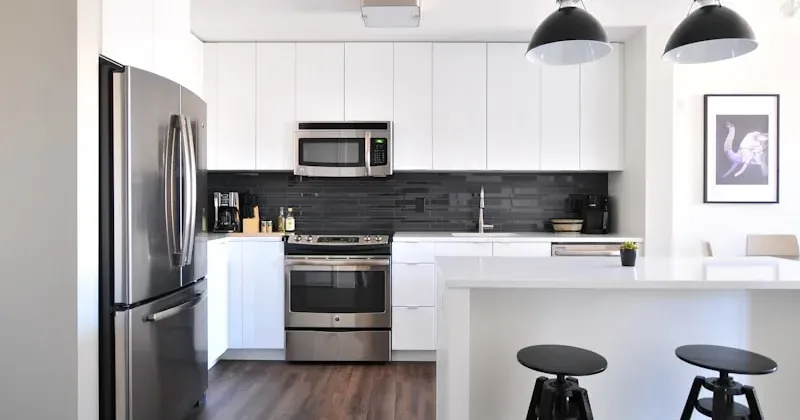
Integrated Laundry in the Kitchen: How to Design a Functional Space
In many apartments, a separate laundry room is a luxury that doesn't exist. The most common solution is integrating the washing machine (and sometimes dryer) within the kitchen. The challenge: making it not look like a laundry room. The right facades are key to achieving this.
Why Integrate Laundry in the Kitchen
Housing reality imposes limits. In one and two-bedroom apartments, there's rarely a separate laundry room. Even in three-bedroom units, the laundry is often a minimal enclosed balcony where the washing machine barely fits. Integrating laundry in the kitchen has concrete advantages:
- Water and drainage connections available: The kitchen already has the necessary installations, avoiding additional construction.
- Space utilization: A kitchen module housing the washer takes up the same space as a standard base cabinet.
- Controlled aesthetics: With facades hiding the washer, nobody knows it's there.
- Counter proximity: You can use the kitchen counter for folding, stain treatment, or sorting clothes.
Integration Options
1. Under-Counter Module with Door
The simplest option. The washing machine sits below the counter, in a shelf-free opening, with a facade door hiding it. Requirements:
- Clear width of 60-65 cm (most washers measure 59-60 cm wide).
- Minimum depth of 55-60 cm (plus space for hoses behind).
- Reinforced hinges for wide doors (or two narrower doors).
- Ventilation: leave a 1-2 cm gap at the bottom or perforate the module base.
2. Laundry Tower
If you have both washer and dryer, a vertical tower stacks them inside a tall unit (oven-tower style). The facade can be two independent doors or one full-height door.
- Height needed: 180-200 cm.
- Width: 65-70 cm.
- Requires reinforced base for combined weight.
- Best option for complete concealment and most integrated look.
3. Laundry Sector Behind Sliding Doors
In spacious kitchens, you can dedicate a complete sector (a wall or corner) to laundry, with sliding doors that hide it completely when not in use. Behind the doors: washer, dryer, utility sink, shelves for products.
Recommended Facades
The golden rule: laundry sector facades must be identical to the rest of the kitchen. If you use natural oak melamine in the kitchen, the washer module gets exactly the same natural oak melamine.
Best-performing materials:
Special Hardware for Laundry Modules
Wide-opening hinges (170°): Allow the door to open completely for easy washer access. With standard 90° hinges, the drum stays partially covered.
Full-extension slides: If the washer sits on a wheeled base or rails, you can pull it out for maintenance without dismounting anything.
Soft-close dampers: Especially important here because the washer generates vibration that can cause doors to open on their own without proper closure.
Technical Installation
Drainage: The washer needs a drain connected to the sewer system. In the kitchen, it's generally connected to the sink drain with a Y-branch.
Water supply: A dedicated shut-off valve for the washer. Don't share the same supply as the kitchen faucet to avoid pressure drops.
Electricity: The washer needs a grounded outlet and ideally an independent circuit on the electrical panel. Don't use power strips or adapters.
Ventilation: This is the most forgotten point. The washer generates heat and humidity. If completely enclosed in a module, you need:
- Ventilation grilles in the base or sides of the cabinet.
- Don't seal the back completely.
- If possible, leave a few centimeters of space between the washer and module side walls.
Common Mistakes
Measuring too tight: If the opening measures exactly 60 cm and the washer measures 59.5 cm, you'll have problems. Always leave 2-3 cm clearance on each side and above.
Forgetting vibration: The washer vibrates during the spin cycle. If the counter rests directly on the washer module, everything will vibrate. Leave space between the washer top and the counter.
Not planning detergent drawer access: If the washer is under the counter, the upper detergent drawer may be inaccessible when the module door is closed. Verify you can open the drawer with the cabinet door open.
Non-matching facades: A laundry module with a different facade from the rest of the kitchen immediately reveals its function. Invest in making it exactly the same.
Laundry Sector Organization
If you can dedicate a generous sector, organize it like this:
- Lower zone: Washer (and dryer if space allows).
- Middle zone: Auxiliary counter or fold-down ironing board.
- Upper zone: Shelves or cabinet for cleaning products, detergent, fabric softener.
- Side: Extendable rail for hanging freshly washed clothes.
All this can be hidden behind facades that open and close, keeping the kitchen visually clean.
Reference Budget
Integrating laundry in the kitchen with custom facades costs approximately the same as adding one more kitchen module. The main extra costs are:
- Module facades (same material as the rest).
- Special hardware (wide-opening hinges, grilles).
- Plumbing connections if they didn't exist (shut-off valve, drain branch).
- Independent electrical circuit if none exists.
Conclusion
Integrating laundry in the kitchen is the practical solution for most apartments. With facades identical to the rest of the cabinets, hardware designed for the function, and good installation planning, you can have a complete laundry area that disappears behind doors when not in use. The key is planning it from the initial kitchen design, not as an afterthought.