Small Kitchen Optimization: 12 Decisions That Multiply Your Space
How to design a small kitchen that works like a big one. Layout, vertical storage, lighting, and proven tricks.
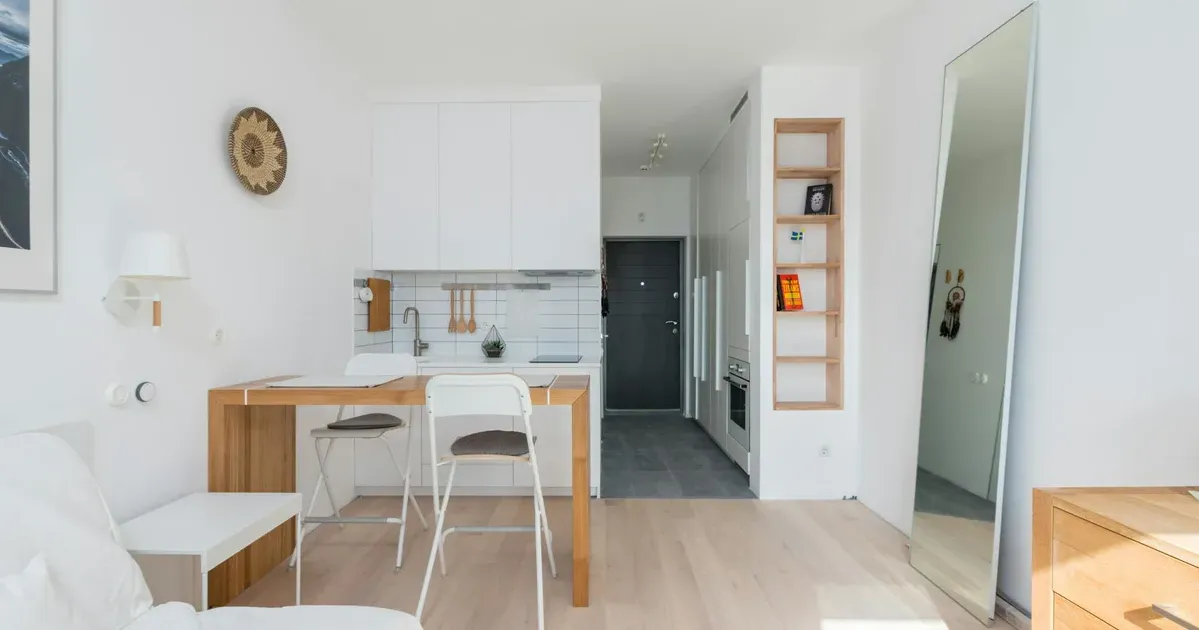
Small Kitchen Optimization: 12 Decisions That Multiply Your Space
A well-designed small kitchen can be more efficient than a poorly conceived large one. The key isn't square meters but how every centimeter is organized. This article walks through twelve concrete decisions that increase function and the sense of spaciousness.
1. Pick the Right Layout
Under 6 m², only three layouts work well:
- Linear: everything against one wall. Ideal for open-plan kitchens or corridors 2 m or less wide.
- L-shape: uses a corner. Adds countertop meters without invading circulation.
- Galley: two facing walls. Maximum efficiency but requires at least 2.2 m between walls.
Avoid U-shape in small spaces: while it maximizes storage, it visually overloads and leaves little circulation.
2. Prioritize Vertical Storage
Floor is scarce, air is free. Cabinets up to the ceiling add 20–30% useful volume without taking surface area. The top 50 cm can hold things you pull out once a year (fine glassware, large pots).
3. Deep Drawers Beat Shelves
Full-extension drawers show all their contents in one gesture. Shelves behind a door hide the back. In small kitchens, where every motion matters, deep drawers for pots and dishes are a high-return investment.
4. Add Drawers Within Drawers
Inside large drawers, interior drawers double capacity by organizing small tools separately from large ones. The "drawer within a drawer" is one of the cheapest upgrades with the biggest practical impact.
5. Uninterrupted Countertop
A continuous countertop, with no visual breaks between appliances, makes the space look bigger. Flush-mount the cooktop, avoid gaps between counter sections, and unify with a single material.
6. Backsplash to the Cabinet
A backsplash that runs from counter to cabinet (no horizontal cut) elongates vertical perception and removes the gray zone where grime accumulates.
7. Three-Level Lighting
- Ambient: ceiling, even, ideally integrated
- Task: under the wall cabinets, over the counter
- Decorative: inside glass-fronted cabinets or niches
A small kitchen with three lighting levels reads as large. A large kitchen with a single central fixture reads as small.
8. Reduce Visible Appliance Count
In small kitchens, three small appliances stacked dominate the visual field. Pick a few multifunctional ones (microwave-oven combo, mixer with attachments) and store the ones you use weekly.
9. Pick Light Colors (with Strategic Exception)
- Light fronts: multiply reflected light
- White or cream cabinets: "vanish" against light ceilings
- Dark accent: allowed on a toe-kick or a base-cabinet island
The rule: darker tones below, lighter above stretches the space vertically.
10. Handleless Fronts or Integrated Pulls
Handles protrude from the front and add visual noise. In small kitchens, push-to-open systems or integrated-pull profiles give a clean reading that boosts the sense of order.
11. Integrated Appliances
An integrated refrigerator (flush with cabinetry) visually disappears. In small kitchens, where any continuous smooth surface is an asset, this matters more than in large ones.
12. Leave at Least One Wall Free
The temptation to fill every corner is strong, but one free wall — with a mirror, a picture, a simple clock — is what separates an organized kitchen from a cluttered one. Functionally it adds no storage; visually it doubles the sense of spaciousness.
Final Check Before Confirming the Order
Before signing the fabrication order:
- Can I open two adjacent doors at the same time?
- Does the fridge open without hitting the wall?
- Is there at least 80 cm of free counter between cooktop and sink?
- Do the cabinets reach the ceiling, or is dust collecting above?
- Do the handles avoid catching when carrying a tray?
A well-thought-out small kitchen doesn't feel small. It feels right-sized.